Showing posts with label Harold Speed. Show all posts

Friday, July 27, 2012

The Music of Line - Harold Speed 12

Another Bargue Plate Copy


This post picks up again in my series on Harold Speed's book on drawing. Here I highlight some points from chapter 11 entitled, "Rhythm: Variety of Line." The entire series can be found on my favorites page.


"A line of equal thickness is a very dead and inexpressive thing compared with one varied and stressed at certain points." -- Harold Speed


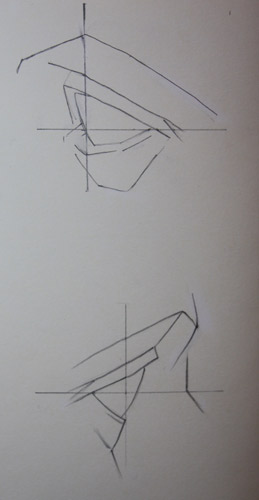
In this chapter, Speed recommends varying your lines to give vitality or "life" to your drawings. I can attest to the truthfulness of this. Just today when I was working on a Bargue plate - when I changed the guide lines (straight lines of uniform thickness) into more weighted lines the drawing seemed to come to life. I had been unhappy with the drawing until that point - then suddenly I saw it was a better drawing than I had thought.


This sort of quality in a drawing is difficult to remember at times. I suppose it should be on a checklist when you evaluate your work. It reminds me of that statement of Robert Beverly Hale where he says becoming good requires "driving all the horses at once." Varied lines are just one of the horses that pull the coach along. Just the other day I was getting lost in a piece and thought to myself - the horses have all broken loose and are trampling the drawing. Knowing the elements of a good drawing is one thing, being able to control and implement them in any one drawing is quite another.


"It is impossible to write of the infinite qualities of variety that a fine draughtsman will get into his line work; they must be studied at first hand. But on this play of thickness and quality of line much of the vitality of your drawing will depend." -- Harold Speed


Speed is channeling Yoda there in that last sentence... :-)

Saturday, June 30, 2012

Rhythm: The Secret to Life in Art - Harold Speed 11


My Closest Neighbor
5in x 7in
colored pencil on paper
copyright 2012 Rose Welty
$45 at my Daily Paintworks Gallery

This post picks up again in my series on Harold Speed's book on drawing. Below are some highlights from the chapter on Rhythm. The entire series can be found on my favorites page.

To encourage you further in your reading - Speed's book on drawing was listed in James Gurney's Survival Manual for Artists.

"The word rhythm is here used to signify the power possessed by lines, tones, and colours, by their ordering and arrangement, to affect us, somewhat as different notes and combinations of sound do in music."
-- Harold Speed

Speed then argues that rhythm is the secret to life in art - without "rhythm" the artwork is cold and dead. This is not surprising given all Speed has previously said about lifeless pieces of perfect workmanship.

He offers that the key to rhythm is unity and variety. Unity is the relationship of parts to the whole - i.e. what holds the whole piece together. Variety "holds the secrets of charm, vitality, and the picturesque."

He notes that Roman works of art look "heavy and dull" next to Greek ones. He claims this difference is because of a lack of rhythm in Roman works. The Romans used circles everywhere - those exceedingly perfect gross roundnesses, whereas Greeks used conic sections - "curves possessed of the greatest amount of variety."

He does caution against too much variety: "variety must always be under the moral control of unity, or it will get out of hand and become extravagant." I love that he says "moral control" there - no one in the art world today would use that terminology, but it's absolutely fitting.

He ends with a good summary on style, composition, and colour:
  • Good style is "variety in unity" (he does not claim this as his own formulation)
  • Good composition is "varying well" (Speed attributes to Hogarth)
  • Good colour is "contrasts in harmony"
The next four chapters of the book concern variety and unity of line and variety and unity of mass. So we'll be looking at that secret to life in a big way!

Friday, June 8, 2012

Gross Roundnesses: Harold Speed 10

Fall - in Fort Worth, years ago
Don't forget the auction for Baby Jayden - it goes through Sunday, June 10.

It's about time for another post in the Harold Speed Drawing Series. This post contains a few highlights from chapter 9 entitled "Mass Drawing: Practical".

My entire series can be found on my favorites page.

Once again, this is an extensive chapter. It should be noted: mass drawing for Speed is always accomplished using a brush and paint. As I am a colored pencil artist, I have to adapt his advice to my situation. I've always thought that was easy though, if I apply my CPs in large areas of color - broad areas made of several strokes instead of the single stroke of the paintbrush.

"Keep your early work both in monochrome and colour quite solid, but as thin as you can, reserving thicker paint for those occasions when you wish to put a touch that shall not be influenced by what you are painting into."
-- Harold Speed

  • Clearly this is about oil painting and drying time - you can make mud very quickly with oil paint.
  • But, I also think it applies to CPs. You want to start your CP work very lightly, very gently - any scratches you make in the paper are forever there, anything heavily applied is nearly impossible to remove or cover, and your ability to blend colors and add more layers depends on there being some tooth left to the paper.
  • I actually read one Australian artist who said that she starts each piece with the feeling that she wants every mark to be removable - she wants every stroke to be undoable until she decides she likes the piece and then goes for it. The step where she decides she likes it is fairly far down the path.

"We saw, in speaking of line drawing, how the character of a line was found by observing its flatnesses and its relation to straight lines. In the the same way the character of modelling is found by observing its planes."
-- Harold Speed

  • Why is it so hard for me to remember this?
"Good modelling is full of these planes subtly fused together. Nothing is so characteristic of bad modelling as 'gross roundnesses' The surface of a sphere is the surface with the least character, like the curve of a circle, and the one most to be avoided in good modelling."
-- Harold Speed
  • Maybe "gross roundnesses" will help me to remember to see individual planes in surfaces and how they meet together!
On a personal note, today officially began our summer break - my posting may drop to once a week for the next few months, we'll see. We spent the morning playing Boggle, which was a huge hit, and then hit the pool in the afternoon - also a big hit. I definitely see sketching at the pool as a big activity for the summer!

Thursday, May 24, 2012

Line Drawing - Tips and Tricks: Harold Speed 9

If memory serves, I took this photo at the Fort Worth Zoo three years ago.

I've been working my way through Harold Speed's book on drawing. Chapter 8 is entitled "Line Drawing: Practical". It is a large chapter full of tips and tricks - it is mostly practical whereas the book thus far has been theoretical. There is way too much in this chapter to put in a single blog post. I can't even prioritize the different tips - so I'm just going to list three quotes that I can benefit from and urge you to read the book yourself!

"Speaking generally, lines of shading drawn across the forms suggest softness, lines drawn in curves fulness of form, lines drawn down the forms hardness, and lines crossing in all directions so that only a mystery of tone results, atmosphere."
-- Harold Speed

  • These "rules" are generally true and can certainly be broken.
  • As a pencil artist who likes showing her marks (leaving my pencil strokes visible) it would be good for me to think about these rules when I'm planning my next piece.


"Don't burden a line drawing with heavy half tones and shadows; keep them light. The beauty that is the particular province of line drawing is the beauty of contours, and this is marred by heavy light and shade."
-- Harold Speed
  • Here Speed is definitely advocating a certain type of line drawing he finds most beautiful.
  • In terms of colored pencil, I think this idea can be used to support high key (all light values) CP drawings. As an art viewer, I love high key paintings. Given my way of working with CPs, high key is good - I find it difficult to get large areas of strong dark color in my work.


"As it is only from one point of view that things can be drawn, and as we have two eyes, therefore two points of view, the closing of one eye will be helpful at first."
-- Harold Speed

  • This is one of the first tips any one gets in any art instruction.
  • It bears repeating though, because it is so easy to focus attention on the exact thing that you are drawing - thereby losing the "glance" viewpoint that made you fall in love with an image. This is definitely an area I'd like to work on.

Wednesday, May 9, 2012

How to Study Drawing: Harold Speed 8


This post gives some highlights from chapter 7, entitled, The Study of Drawing, from Harold Speed's book on drawing. On my favorites page you can see all of the posts in this series.

Up until this point in the book, Speed has discussed that there are two approaches to drawing - a line centered approach and a mass centered one. So, it is natural that he then argues the student should study both aspects of drawing - beginning simultaneously and separately. Essentially, one should draw entirely with line without regard to tone or mass in one drawing and then in the next drawing work entirely with masses and tones, without regard to line. Eventually, the two styles will converge but in the mean time, he argues, there is plenty to learn.

Below I give bullet point lists of Speed's points (because the modern reader finds this easier) but these are essentially quotes from Speed.

Line drawing teaches:
  • accurate observation
  • expressive value of line
  • hand coordination
Mass drawing teaches:
  • the importance of tone values
  • the expression of form by means of planes
If you only study line drawing, you will lack:
  • knowledge of the tone and atmosphere that always envelop form in nature
  • the ability to switch to a brush when you take up painting
If you only study mass drawing, you will lack:
  • accurate observation of all the subtleties of contours and the construction of form
  • understanding of the mental stimulus that the direction and swing  a brush stroke can give

In my own experience, I can definitely say that my studies have been strong in line and weak in mass. I'm therefore very encouraged to spend more time working with masses in my studies. At the top and bottom of this post I've put a few more drawings from my venture into Bargue's drawing course - these are focused line drawings aiming at observation and accuracy - and it appears I need work there too!


Friday, May 4, 2012

Lifeless Piece of Perfect Workmanship: Harold Speed 7

Bargue Drawing Course, my beginning

This post contains highlights from chapter 6, of Harold Speed's book on drawing. The chapter is called "The Academic and Conventional". You can find all posts from this series on my favorites page.

"academic drawing is all that can be really taught, and is as necessary to the painter as the practicing of exercises is to the musician, that his powers of observation and execution may be trained."
-- Harold Speed

In this chapter Speed argues that academic drawing (studying how to draw well) is necessary. He argues that academic studies train the eye to observe accurately and train the hand to reproduce appearance.

"But the vital matter of art is not in all this necessary training." -- Harold Speed

So when is a drawing good?

"The test is whether it has life and conveys genuine feeling." -- Speed

Why is not a drawing's accuracy a measure of goodness?

"It would seem that, after a certain point, the nearer your picture approaches the actual illusion of natural appearance, the further you are from the expression of life...The nearer you approach the actual in all its completeness, the more evident is the lack of that movement which always accompanies life."
-- Harold Speed

Finally, with those necessary exercises mentioned above in mind, I have begun working my way through the famous Bargue Drawing Course. You see my first drawings above.

Monday, April 30, 2012

Painter's First Necessity: Harold Speed 6

This colored pencil drawing I did as part of an oil painting class with Susan Carlin. This drawing was built up in masses of color - refined to different degrees throughout it.
This post contains highlights from chapter 5, entitled Mass Drawing, of Harold Speed's book on drawing. This is the sixth post in the series, you can find all of the posts on my favorites page.

"If only the accurate copying of the appearances of nature were the sole object of art (an idea to be met with among students) the problem of painting would be simpler than it is, and would be likely ere long to be solved by the photographic camera."
-- Harold Speed

"...the problem of painting would be simpler than it is..." Another way to say that - it is harder to be more than camera than it is to be just a camera. In our day and age, where everything seems to have a camera as part of it, it is vital to be more than a camera as an artist. After all, add a photoshop sketch filter to the camera set up and you have a accurate camera drawing.

"The reducing of a complicated appearance to a few simple masses is the first necessity of the painter."
-- Harold Speed

Speed doesn't say how to achieve those simple masses - that is coming up in another chapter. He also makes the point that the painter must deal with masses as he has a brush fat with paint in his hand and not a pencil. With the limited painting experience I have, he is indeed right - it isn't easy to maintain a fine line with a brush for very long in painting.

I work with pencils and not brushes but I do try to work in masses first. Especially with colored pencil - a medium requiring lots of layering - it has improved my work to think in terms of big chunks of color that I refine with each layer. I might make small thin lines individually, but I lay them down in big masses on the paper (all jammed together).

Thursday, April 26, 2012

Not Until da Vinci: Harold Speed 5

My piece of an upcoming project for DC114 of CPSA

This post contains highlights from Harold Speed's Practice and Science of Drawing, chapter 4 entitled Line Drawing. You can find all of the posts in this series here.

"Light and shade were not seriously perceived until Leonardo da Vinci. And a wonderful discovery it was thought to be, and was, indeed, although it seems difficult to understand where men's eyes had been for so long with the phenomena of light and shade before them all the time."
-- Harold Speed

I just love the frankness of Harold Speed. Of course, he's right - how could we have missed for so long? Indeed, how could we each individuality miss it until someone points it out to us in an art class?

In this chapter Speed makes a multi-faceted argument about the importance of line:
  • imaginative works are often strong in line (William Blake and his Job illustrations)
  • as an emotional stimulus (violence or calm, depending on the flow of lines in the work)
  • it enables the artist to direct the attention of the viewer
  • there is a harmonic (rhythmic) sense in line
"no work that aims at a sublime impression can dispense with the basis of a carefully wrought and simple line scheme."
-- Harold Speed

This reminds me very much of my study of notan, done years ago now. Here's a post where I quote Arthur Wesley Dow saying much the same thing as Harold Speed. If you are interested in line and notan, Making a Mark's Katherine Tyrrell also studied this topic - a great post of theory and practice on notan. She also made a lens about all the different facets of her study on composition.

Finally, congrats to the five DC114 members who got works in the international show this summer! They are a talented group and I am blessed to live in NC and be a part of their chapter.

Tuesday, April 24, 2012

Shocking State of Neglect: Harold Speed 4

Sketch after Mary Cassatt

This post is a brief summary and highlights from chapter 3, entitled Vision, in Harold Speed's Practice and Science of Drawing. You can find all of the posts here.

"If so early the sense of vision is neglected and relegated to be the handmaiden of other senses, it is no wonder that the average adult is in such a shocking state of neglect." 
--Harold Speed

Speed demonstrates that the sense a child consults when they first draw the face is touch - not sight. This is why they draw outlines around things that do not have outlines in real life. I'm not going to retrace his argument, but he makes a convincing one - it's true what we first draw has very little in common with how we actually see.

From here he concludes that there are 2 ways to "see":
  • mental perception - derived from our sense of touch (outlines, where our hand would travel)
  • visual perception - arrangement of colors on the retina (vision as a mosaic of color)
These give 2 different ways to approach representing the visible on paper (drawing):
  • line drawing (mental perception)
  • mass drawing (visual perception)
"The visual blindness of the majority of people is greatly to be deplored, as nature is ever offering them on their retina, even in the meanest slum, a music of colour and form that is a constant source of pleasure to those who can see it."
-- Harold Speed

"It is the privilege of the artist to show how wonderful and beautiful is all this music of colour and form, so that people, having been moved by it in his work, may be encouraged to see the same beauty in the things around them."
-- Harold Speed

Finally, I just wanted to say thank you to those of you who have taken the time to send an email or leave a comment to let me know that you are enjoying this series. It is very encouraging to hear - I appreciate it.

Saturday, April 21, 2012

Life at Second Hand: Harold Speed 3

Sketch of Wildflower done in 2009
copyright 2009-2012 Rose Welty


This post is a summary of highlights in Harold Speed's Practice and Science of Drawing, chapter 2 entitled Drawing. You can find the series (to date) on my favorites page.

"Art...enables us to experience life at second hand."
-- Harold Speed


"There is a feeling of being lifted out of one's puny self to something bigger and more stable."
-- Harold Speed


Who doesn't want their drawing to be described by those two statements? I'm sure I've mentioned it before, but I remember as a child going to a Degas exhibit (I believe it was at the Huntington Library) and thinking to myself that I could smell the sweat of those ballet rooms, I could hear the sounds. It made me want to learn to draw - it seemed an amazing ability.

" Drawing, then, to be worthy of the name, must be more than what is called accurate. It must present the form of things in a more vivid manner than we ordinarily see them in nature."
-- Harold Speed

Notice that he says *more* than accurate, meaning that accurate drawing is a bare necessity, not a "nice to have." He says to create worthy drawings an artist must be able to select the essential or expressive elements in a subject.

Speed urges the art student to "let your aim be a searching accuracy" - arguing from the lesser to the greater:

"For how can the draughtsman who does not know how to draw accurately the cold, commonplace view of an object, hope to give expression to the subtle differences presented by the same thing seen under the excitement of strong feeling?"
-- Harold Speed


Wednesday, April 18, 2012

Something Better Than Copying: Harold Speed 2

Dogwood Branch
5in x 7in
colored pencil on paper
copyright 2012 Rose Welty
$45


"It is surprising how few art students have any idea of what it is that constitutes art." 
 --Harold Speed


Continuing on from last time, I've got a few tidbits from the introduction to Harold Speed's The Practice and Science of Drawing.

Speed spends the introduction (chapter 1) discussing what constitutes art, seeing as he feels that most art students don't know what it is. You have to love the frankness. ;-)

"It is highly essential that they [art students] have some better idea of art than that it consists in setting down your canvas before nature and copying it."
-- Harold Speed

If you take one thing from the chapter, that's it. Art is not photography. He has plenty to say about the necessity of accuracy, he just feels it is more of a "given" or basic thing that should be there and then the artist needs to go beyond that.

Speed also gives his goal for the education of a painter:
"The study, therefore, of the representation of visible nature and of the powers of expression possessed by form and colour is the object of the painter's training."
-- Harold Speed

Dogwood Branch is available for purchase. It will come to you matted to 8in x 10in and ready for framing.
Choose your delivery

Tuesday, April 17, 2012

Artistic Indigestion: Harold Speed 1 - Preface

After Degas - a sketch copy I did a few years ago


"It is no wonder that a period of artistic indigestion is upon us."
--Harold Speed

I'll come back to the quote in a minute.

Do you have any books that you reread on occasion? Harold Speed's The Practice and Science of Drawing is one that I've read a few times before and always come away thinking that I missed a good bit of it.

I saw it mentioned on James Gurney's blog the other day and thought it was about time I revisited it. The book is full of fun quotes, so I though I'd share some of my favorites here on the blog. So, today I'm hopefully beginning a series through Harold Speed's book - not comprehensive or sequential, but regular enough and I'll tag all of the posts with Harold Speed so that you can find them all.

From the preface....


"It is no wonder that a period of artistic indigestion is upon us."
  • That is just a funny sentence.
  • If you substituted " information " for "artistic" you'd have a fabulous summary of the internet age.
  • But he's really talking about how easy it is get access to quality reproductions of art from many different traditions. He wrote that a hundred years ago - all the more in our day.
  • He argues that you need some basic artistic principles to help you navigate the rich and turbulent seas of the art world. Once you learn a few fundamentals you can understand art across culture and time. I certainly know from personal experience that some art takes a bit of studying to truly understand and appreciate. But, that art was worth the effort! :-)